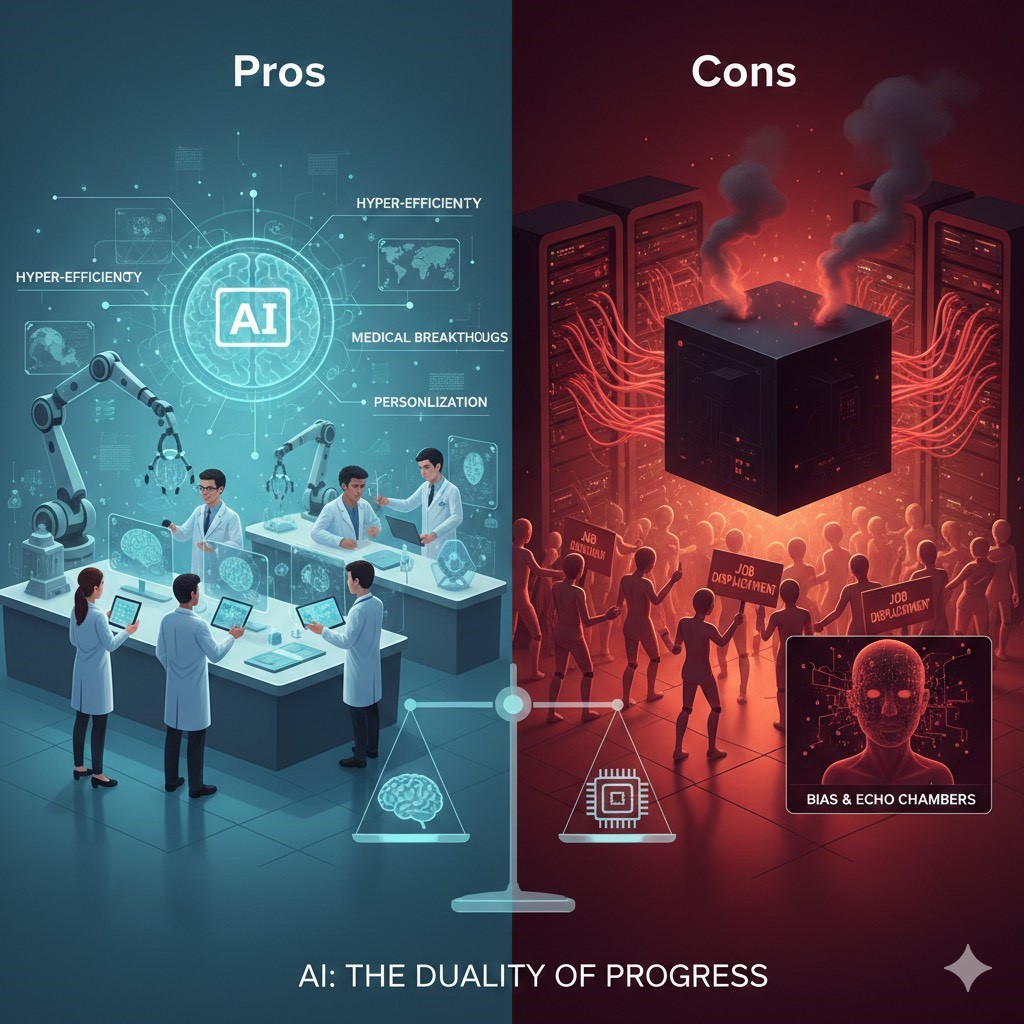
The Landscape of AI Uptake
The adoption of AI has shifted from passive (algorithms working behind the scenes) to generative (AI you can talk to). Companies are no longer asking if they should use AI, but how fast they can integrate it before they’re left in the digital dust.
The Pros: Why We’re Diving In
Hyper-Efficiency• Hyper-Efficiency: AI doesn't get tired, bored, or need a coffee break. It handles repetitive tasks—like data entry or sorting massive datasets—at speeds humans can’t touch.
Medical Breakthroughs
• Medical Breakthroughs: AI excels at pattern recognition. It can spot early-stage tumors in scans or predict protein structures for new drug developments that would take humans decades to solve.
Personalization at Scale
• Personalization at Scale: Whether itʼs education tailored to a student’s specific learning gaps or a retail experience built around your taste, AI makes "one-size-fits-all" a thing of the past.
Safety in Extremes
• Safety in Extremes: We send AI-driven rovers to Mars and drones into disaster zones, keeping human lives out of immediate danger.
The Cons: The Growing Pains
• As AI becomes more complex (like Deep Learning), even the creators sometimes struggle to explain how the machine reached a specific conclusion. This lack of transparency is a major hurdle for accountability.
Job Displacement
• Storing sensitive data offsite can raise concerns about data breaches, unauthorized access, and compliance with regulations.
Bias and Echo Chambers
• AI is only as good as the data itʼs fed. If the data contains human prejudices, the AI will likely automate and scale those biases, leading to unfair outcomes in hiring or law enforcement.
Resource Intensity
• Training massive models like GPT-4 requires staggering amounts of electricity and water for cooling data centers, raising significant environmental concerns.
A Quick Comparison
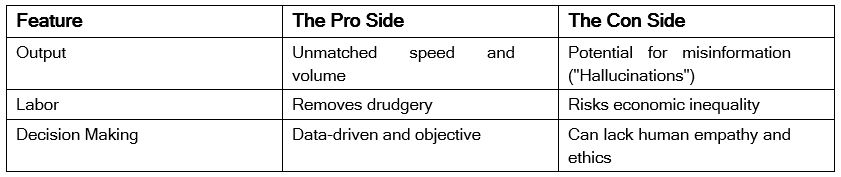
The Bottom Line: AI is a tool, not a crystal ball. Its value depends entirely on the hand that swings it. We are currently in the "wild west" phase where the tech is outpacing the laws meant to govern it.
That's a sharp, balanced take on AI's explosive growth—love the Industrial Revolution analogy. It captures the hype, the wins, and the real risks without sugarcoating. Here's my quick feedback and a polished rewrite to tighten it up for even more impact, say for a blog post or newsletter.
AI's Rise: The Second Industrial Revolution, Automating Thoughts
AI isn't just a tech trend—it's the second Industrial Revolution. This time, we're automating thoughts, not steam engines. From niche academia to powering your commute, playlists, and diagnoses, AI is everywhere.>AI-driven decision making is not a new concept, but its rapid acceleration in recent years—fueled by a surge in adoption and expanding real‑world applications—has pushed it to the center of global conversation. As AI systems increasingly influence decisions, whether supporting human judgment or operating autonomously, the ethical considerations extend far beyond simple mistakes or technical errors. Where AI should be deployed? How do we define the boundaries? The growing ability of AI to make decisions on our behalf raises profound questions about human autonomy, fairness, bias, and the trust we place in technology within an increasingly automated world.
AI is undeniably transformative, offering unprecedented opportunities and efficiencies. When applied responsibly, it has the potential to elevate decision making across industries. Yet the critical question remains: How much control are we truly comfortable relinquishing?
The Shifting Landscape
AI adoption has evolved from passive algorithms (behind-the-scenes work) to generative tools you can chat with. Companies aren't debating if to use AI—they're racing to integrate it or get left behind.The Wins: Why we’re All In
• Hyper-Efficiency: AI crushes repetitive tasks like data entry or dataset sorting at superhuman speeds—no breaks needed.• Medical Miracle: It spots tumors early in scans and predicts protein structures for drugs, solving problems that stump humans for decades.
• Personalization at Scale: Tailored education fills learning gaps; shopping adapts to your tastes. Goodbye, one-size-fits-all.
• Safety in Danger Zones: AI rovers explore Mars; drones tackle disasters—humans stay safe.
The Risks: Growing Pains We Can't Ignore
• Black Box Mystery: Complex models like deep learning baffle even creators on how decisions happen, complicating accountability.• Job Shakeups: New roles emerge, but old ones vanish. Upskilling millions is a messy transition.
• Bias Amplification: Garbage in, garbage out—AI scales human prejudices, skewing hiring, policing, and more. New roles emerge, but old ones vanish. Upskilling millions is a messy transition.
• Environmental Toll:Training giants like GPT-4 guzzles electricity and water for data centers.
Quick Pros vs. Cons
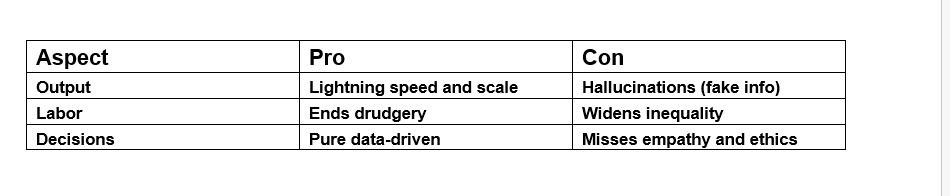
Bottom Line: AI is a tool, not magic. Its power hinges on wise use. We're in the Wild West—tech sprinting ahead of laws.
"AI isn't just code—it's the steam engine of the mind. The second Industrial Revolution has begun. Who's ready to rethink everything?"
Technology is a powerful enabler, but it's the people behind it who truly make AI exceptional.
About the Author: Jmaal Bawazir | Freelance Consultant | Cmd Alt Fix U.K. Connect with me on LinkedIn: https://www.linkedin.com/in/jmaalbawazir
© 2026 Cmd Alt Fix | All Rights Reserved
hidden
© 2026 | MMXXVI All Rights Reserved. | Cmd Alt Fix | United Kingdom | www.cmdaltfix.uk